
Mobile Fingerprinting for Schools in Florida: A Guide to On-Site Compliance
What if you could clear your entire staff for the upcoming school year without a single teacher leaving their desk? Coordinating Level 2 background checks often feels like an administrative bottleneck that disrupts the flow of your campus. It's frustrating to manage specific Florida Department of Education (DOE) codes while trying to prevent staff downtime during critical prep weeks. You're responsible for ensuring every employee and volunteer meets the strict standards of the Jessica Lunsford Act, yet the logistics of individual travel to off-site labs often create a paperwork nightmare.
This guide explains how mobile fingerprinting for schools Florida transforms a complex regulatory burden into a single, efficient on-site event. You'll learn how to streamline the Live Scan process to achieve full compliance with minimal friction. We will walk you through navigating ORI number requirements and managing large volumes of electronic submissions. By the end of this article, you'll have a clear roadmap to getting your team cleared before the first bell rings. This approach allows you to focus on education and safety rather than bureaucracy.
Key Takeaways
Identify the specific Level 2 screening requirements mandated by the Jessica Lunsford Act to ensure every staff member and volunteer is fully compliant.
Discover how mobile fingerprinting for schools Florida eliminates travel time and administrative delays by bringing Live Scan technology directly to your campus.
Learn to navigate Florida Department of Education (DOE) and JLA codes to ensure background checks reach the correct agencies without error.
Optimize your school calendar by scheduling on-site fingerprinting during faculty meetings or registration events for maximum efficiency.
Partner with a local expert in Tampa Bay to handle complex FDLE submissions and mandatory photo requirements with surgical precision.
Table of Contents
Navigating Florida School Fingerprinting Requirements in 2026
Understanding Compliance: The Jessica Lunsford Act & Level 2 Screening
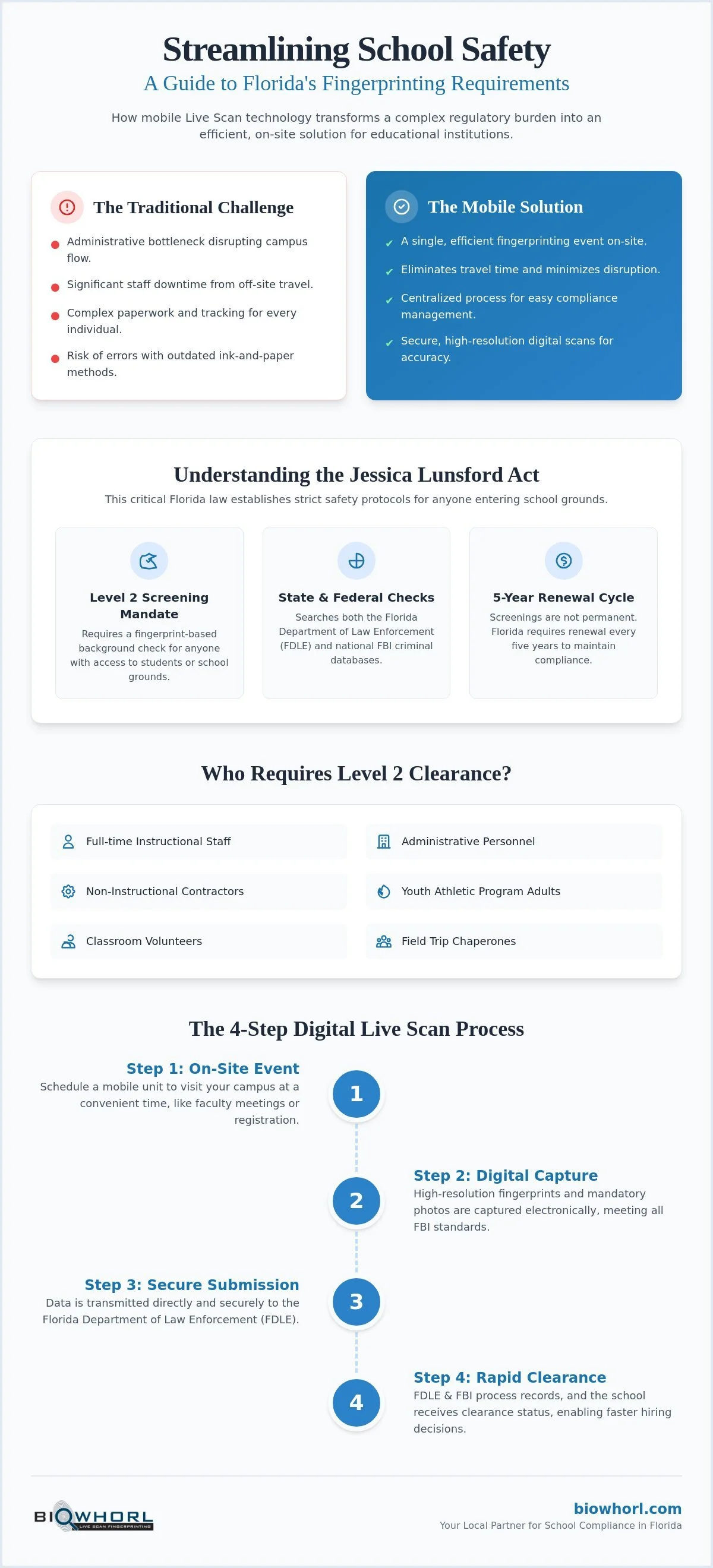
Mobile vs. Traditional Fingerprinting: Efficiency for Educational Institutions
BioWhorl Fingerprinting: Your Local Partner for School Compliance in Florida
Navigating Florida School Fingerprinting Requirements in 2026
Florida's school safety standards are rigorous and uncompromising. The state now mandates digital-only submissions for all Level 2 background checks. Paper cards are obsolete and no longer accepted by the Florida Department of Education (DOE). This shift prioritizes data security and processing speed. It ensures that sensitive criminal history data moves securely from the collection point to state and federal databases without the risks associated with physical mail. Utilizing mobile fingerprinting for schools Florida provides a direct path to compliance. It eliminates the need for staff to find local labs on their own time while ensuring the school remains in total alignment with state law.
The transition to electronic Live Scan processing solves the "unclassifiable" print problem common with traditional ink. Digital sensors capture high-resolution images that meet FBI standards on the first try. This efficiency is vital for high-volume hiring periods before the school year starts. Schools can now track submission status through the DOE or DCF Clearinghouses. This visibility prevents redundant testing and simplifies the administrative burden on HR departments. It's a streamlined approach designed for a modern educational environment.
Who Requires Level 2 Clearance?
Employee and volunteer screening isn't a suggestion; it's a legal obligation. The Jessica Lunsford Act dictates that anyone with access to school grounds when students are present must pass a Level 2 check. This includes full-time instructional staff and administrative personnel. It also covers non-instructional contractors who may be on-site for maintenance or food services. As of July 1, 2026, Florida Statute 943.0438 expands these rules significantly. Now, all adults involved in youth athletic programs, including those affiliated with schools, must undergo this screening. Classroom volunteers and field trip chaperones also fall under these protocols to maintain student safety at all times.
The Role of the Florida Department of Law Enforcement (FDLE)
The FDLE functions as the central clearinghouse for all state background data. When a mobile vendor performs a Live Scan, the data transmits directly to the FDLE systems. They process the Florida-specific records and then interface with the FBI for national results. Level 2 screening is a state-mandated check against both Florida and FBI criminal records. This integration ensures that school districts receive comprehensive, real-time alerts if a staff member's status changes. Modern Live Scan systems reduce the chance of manual errors or rejected prints. The process is fast, secure, and entirely electronic, allowing for quicker hiring decisions and safer campuses.
Understanding Compliance: The Jessica Lunsford Act & Level 2 Screening
The Jessica Lunsford Act emerged as a response to a 2005 tragedy. It established strict safety protocols for anyone entering Florida school grounds. The law mandates that individuals with student contact or access to school grounds when students are present must undergo thorough background checks. This Level 2 Screening involves a fingerprint-based search of both Florida and FBI criminal records. It isn't just for faculty. It includes any worker who might step foot on campus. Compliance is non-negotiable for anyone who isn't under the direct, constant supervision of a cleared school employee.
Managing a large roster of vendors shouldn't be a full-time job. The "Requirement-to-Relief" model addresses this directly. The requirement is a complex legal mandate that threatens your operational timeline. The relief is a mobile unit that arrives on your schedule. This transition simplifies compliance for everyone involved. It removes the burden of proof from the vendor and places the control back in the school's hands. Utilizing mobile fingerprinting for schools Florida offers an immediate solution. Instead of tracking whether a contractor visited a lab, you bring the lab to the job site. This ensures every individual is cleared before they start work.
JLA Requirements for Non-Instructional Personnel
Identifying which contractors need immediate clearance is the first step. Any individual who is permitted access to school grounds when students are present must be screened. These screenings aren't permanent. Florida requires a five-year renewal cycle to maintain active status. Mobile services help third-party vendors meet tight school entry deadlines. It's an efficient way to manage high volumes of personnel without creating logistical delays. It's about keeping the workflow moving while maintaining a secure environment for students.
AHCA and DOE Integration
Navigating the Background Screening Clearinghouse (BGS) can be complex. For school-based healthcare providers, AHCA photo submission is a mandatory component of the process. This creates an extra layer of administration. A single on-site session can coordinate multiple agency submissions. You can capture fingerprints and photos simultaneously. This integrated approach ensures that data reaches the right clearinghouse quickly. If you need to streamline this process for your campus, consider scheduling mobile on-site fingerprinting to handle all requirements at once. Schools save hours of paperwork by centralizing these submissions during a single event.
Mobile vs. Traditional Fingerprinting: Efficiency for Educational Institutions
Traditional fingerprinting places the logistical burden on the employee. Staff must find an approved lab, schedule an appointment, and drive off-campus during business hours. This results in significant lost instructional time and complex administrative tracking. Mobile fingerprinting for schools Florida removes these obstacles by centralizing the entire operation. You can clear an entire department or an entire campus during a single faculty meeting. This approach ensures 100% compliance by a specific deadline. You no longer need to chase individual receipts or confirmation emails from dozens of different staff members.
Managing ORI numbers at scale is a frequent administrative hurdle. Different roles often require different codes for the Florida Department of Education or the Volunteer and Employee Criminal History System (VECHS). When individuals visit various labs, they frequently provide incorrect codes. This results in rejected submissions and non-refundable fees. On-site mobile sessions allow a compliance expert to pre-configure the Live Scan system with your school's specific codes. This level of precision guarantees that background data reaches the correct agency without manual intervention or data entry errors.
Eliminating Staff Downtime
Productivity losses from off-site visits add up faster than most administrators realize. If 30 teachers spend two hours each on travel and testing, your school loses 60 hours of critical preparation time. Group fingerprinting is the current operational standard for charter school openings and large-scale faculty workdays. It provides "anywhere, anytime" convenience that respects the teacher's schedule. Administrators can monitor the process in real-time. You know exactly who has completed their Level 2 check before the session ends. This eliminates the uncertainty of waiting for staff to report their status.
Accuracy and Submission Speed
Digital Live Scan technology offers superior accuracy compared to traditional methods. The software provides immediate feedback on print quality. It alerts the technician if a scan is smudged or incomplete. This real-time validation prevents the "rejected print" notifications that often arrive weeks after an employee has started work. Instant electronic submission to the FDLE significantly accelerates the hiring cycle. You receive results faster, which is vital when filling urgent positions just days before the semester begins. Utilizing mobile fingerprinting for schools Florida also ensures that your data is transmitted via secure, encrypted channels directly to state authorities, protecting sensitive personal information at every step.
Planning Your On-site Fingerprinting Event in Tampa Bay
Organizing a school-wide screening event requires careful logistical coordination. The goal is to clear a large volume of staff with zero disruption to the educational day. Timing is everything. Most successful events occur during summer orientation, teacher workdays, or registration weeks. This ensures that every individual is cleared before students return to campus. Communicating ID requirements early is essential. Participants must bring a valid government-issued photo ID, such as a Driver’s License or Passport, to their session. Without these documents, the Live Scan cannot proceed. Providing a clear checklist to your staff two weeks before the event prevents delays on the day of the scan. It's a simple step that keeps the entire schedule on track.
Receiving electronic confirmation for every submission is the final piece of the planning puzzle. This digital paper trail is vital for proving compliance during state audits. It removes the guesswork from the hiring process and provides immediate peace of mind for administrators. If you're ready to secure your campus for the upcoming term, you can book mobile on-site fingerprinting to streamline your next orientation event. We handle the technical details so your team can stay focused on the classroom. This proactive planning ensures your school is ready for the first day of classes without any last-minute screening hurdles.
The Critical Role of the ORI Number
An ORI Number, or Originating Agency Identifier, is a unique nine-character code. It tells the FDLE exactly where to send the background check results. Schools usually find this code through the Florida Department of Education or their specific school district office. Using an incorrect ORI code is a costly mistake. It results in background checks being routed to the wrong agency, which often requires the applicant to pay for a second scan. Results sent to the wrong department can't be transferred easily. BioWhorl Fingerprinting helps schools verify these codes before the event begins to ensure 100% accuracy in agency routing. Choosing mobile fingerprinting for schools Florida ensures that an expert double-checks these codes on-site before a single print is taken.
Logistics for Large Group Sessions
Handling 20 or more staff members requires an efficient flow. A school library, conference room, or administrative office works best. You should designate a quiet space that allows for privacy during the data entry phase. Each Live Scan session typically takes 5 to 10 minutes per person. This speed allows a single mobile unit to process a dozen employees in under two hours. Professional mobile units require only a standard power outlet and a small table to process a full staff. This minimal footprint allows you to set up in almost any available room without rearranging furniture. Maintaining a structured schedule, such as five-minute increments, keeps the process moving without creating a crowded waiting area.
BioWhorl Fingerprinting: Your Local Partner for School Compliance in Florida
BioWhorl Fingerprinting provides the technical bridge between local schools and state regulatory bodies. We specialize in Level 2 Live Scan fingerprinting for the Florida Department of Education. Our service is tailored to the specific needs of the educational sector. This includes handling AHCA photo submissions for school-based health clinics and athletic departments. We operate with surgical precision. Our technicians understand the high stakes of background screening accuracy. We ensure that every submission follows the correct routing for state and federal processing. This eliminates the risk of rejected applications and administrative delays. Our equipment uses state-of-the-art digital sensors to capture high-resolution prints on the first attempt. We provide a steady hand in a process that is often defined by complex legal and employment hurdles.
Serving the Tampa Bay Area
Our mobile units provide comprehensive coverage across the entire Tampa Bay region. We serve schools in Plant City and throughout Hillsborough County with efficient on-site sessions. We understand the unique vendor requirements of Pinellas County schools. Our team offers direct support for St. Petersburg charter and private school boards to maintain high safety standards. We accommodate the flexible scheduling needs of administrators in Clearwater and surrounding communities. Whether you're opening a new campus or conducting an annual staff renewal, we bring the compliance lab to your location. This local expertise ensures that we understand the specific ORI numbers and agency codes required for your district. We act as a reliable partner for educational institutions of all sizes. We know the local landscape and the specific expectations of Florida school districts.
The BioWhorl Fingerprinting "Requirement-to-Relief" Process
The BioWhorl Fingerprinting "Requirement-to-Relief" process removes the stress of background check logistics. The requirement is a mandatory, high-stakes FDLE and FBI submission. The relief is our professional, on-site facilitation. We manage the technical data entry and secure, encrypted transmission. This allows your administration to focus entirely on students and curriculum. Our approach is calm and dependable. We handle sensitive background check hurdles with quiet competence. We act as an essential link in your hiring chain. Utilizing mobile fingerprinting for schools Florida means you don't have to worry about staff downtime or travel logistics. We ensure the process is fast and utilitarian. Every scan is captured and verified before we leave your site. You receive immediate electronic confirmation for every participant. This level of service provides the clarity you need to navigate complex state regulations with minimal friction.
Schedule your on-site school fingerprinting session today to ensure your campus is fully compliant for the new school year. Our team is ready to facilitate your next group event with the speed and clarity your school deserves.
Secure Your Campus Compliance Today
Achieving full compliance with the Jessica Lunsford Act doesn't have to be a logistical burden. By moving away from individual lab visits, schools can eliminate staff downtime and ensure every background check is routed correctly the first try. Using mobile fingerprinting for schools Florida provides a centralized solution that fits into your existing orientation or faculty workday schedule. You gain the security of professional Live Scan technology without the administrative headache of tracking individual receipts or verifying distant lab appointments.
BioWhorl Fingerprinting acts as a steady hand throughout this complex regulatory process. As an FDLE and FBI Approved Live Scan Provider, we offer specialized AHCA and DOE background check support. We serve the educational communities of Tampa, St. Petersburg, and Clearwater with surgical precision and a commitment to efficiency. Our mobile units arrive prepared to handle your entire staff in a single, streamlined session. We manage the technical details so you can focus on preparing your campus for students.
Book Professional Mobile Fingerprinting for Your Florida School
Start the school year with confidence knowing your campus is safe and fully compliant.
Frequently Asked Questions
What is the Jessica Lunsford Act and does my school need to comply?
The Jessica Lunsford Act is a Florida law that mandates Level 2 background screening for any individual permitted access to school grounds when students are present. All Florida public, charter, and private schools must comply with these standards. This requirement applies to employees, contractors, and certain volunteers. Compliance ensures that individuals with a history of specific criminal offenses are not permitted on campus. It's a non-negotiable safety standard for the state's educational system.
How long does a mobile fingerprinting session for a school staff take?
A standard Live Scan session typically takes between 5 and 10 minutes per person. This includes the time required for data entry, identity verification, and the digital capture of all ten fingerprints. Because the process is entirely electronic, there's no waiting for ink to dry or cards to be processed manually. This speed allows a single technician to clear a large faculty group during a single morning or afternoon session without disrupting the school day.
What is an ORI number for Florida Department of Education background checks?
An ORI number is a unique nine-character identifier used by the FDLE to route background check results to the correct agency. Schools must provide the specific ORI associated with the Florida Department of Education or the Volunteer and Employee Criminal History System (VECHS). Using the correct number is vital. If an incorrect code is used, the results will be sent to the wrong department, often requiring the applicant to repeat the entire process and pay additional fees.
Can mobile fingerprinting units handle AHCA photo submissions for school nurses?
Yes, professional mobile units can capture and submit the digital photos required for the AHCA Background Screening Clearinghouse. This is a mandatory requirement for school health clinics and nurses who fall under AHCA oversight. Capturing the photo and fingerprints simultaneously streamlines the process for medical staff. It ensures that all necessary data is transmitted to the clearinghouse in a single session, preventing administrative delays in hiring or credentialing school healthcare providers.
Is Level 2 Live Scan fingerprinting more accurate than traditional ink?
Live Scan technology is significantly more accurate than traditional ink because the software provides real-time validation of print quality. The system alerts the technician immediately if a scan is smudged or incomplete. This eliminates the "unclassifiable" errors that frequently occur with paper cards. By ensuring high-resolution captures on the first attempt, schools avoid the frustration of rejected prints and the need for staff to return for a second screening session weeks later.
How far in advance should our school book a mobile fingerprinting event?
You should ideally book your on-site event two to four weeks in advance to secure your preferred date. Peak periods, such as summer orientation in July and August or the start of spring athletics, fill up quickly. Early booking allows your administration time to communicate ID requirements and ORI numbers to all participants. This lead time ensures that your mobile fingerprinting for schools Florida session is scheduled exactly when your faculty and contractors are already on campus for workdays.
What identification do teachers need to bring to the mobile fingerprinting unit?
Teachers and staff must present a valid government-issued photo identification at the time of their scan. A state-issued Driver's License or a U.S. Passport are the most common and widely accepted forms of ID. The technician must verify the individual's identity against the data entered into the Live Scan system. Without a physical, valid ID, the screening cannot proceed. It's helpful to provide a reminder to all staff members 24 hours before the mobile unit arrives on campus.
Are mobile fingerprinting results accepted by the FDLE and FBI?
Yes, all digital submissions from an authorized mobile unit are transmitted through secure, encrypted channels directly to the FDLE and FBI. These results are fully accepted for Level 2 background checks in Florida. Utilizing mobile fingerprinting for schools Florida ensures that your data meets the latest technical standards for state and federal processing. Once the scan is complete, the results are routed electronically to the requesting agency's clearinghouse, typically within a few business days.